




Stay at home mom burnout is a state of deep, lasting exhaustion from parenting with too little relief, often paired with feeling emotionally distant from your kids and like you are failing at the job. It builds when the demands of being home full time outweigh your resources for long enough, and recovery means changing that equation, not just pushing through.
If you love your kids and still dread the sound of them waking up, you are not a bad parent. You are a depleted one. This guide covers what researchers have learned about parental burnout, why at-home parents are especially exposed, and a recovery plan built for a house where the shift never ends.
What Parental Burnout Actually Is
Parental burnout is a recognized research concept, not a buzzword. Belgian researchers built a questionnaire to measure it in two online studies of 379 and 1,723 parents. They found it has three parts: overwhelming exhaustion in the parenting role, feeling ineffective as a parent and emotional distancing from your children (Roskam et al., 2017). It overlapped only modestly with job burnout, general parenting stress and depression, which suggests it is its own thing.
The same team followed 923 parents over time and found that burnout tracked a chronic imbalance: parenting risks and stressors outweighing the resources that ease them (Mikolajczak et al., 2018). That is useful, because it means recovery is about lowering the load and raising the support, not about trying harder.
Your body notices, too. In one study, parents with burnout had hair cortisol levels about twice as high as parents without it, a marker of long-running stress, though there was plenty of overlap between the groups (Brianda et al., 2020).
Why Stay at Home Mom Burnout Hits So Hard
Being home full time is real work with some unusual features.
- No shift end. There is no commute home that marks the switch from work mode. You are on from the first "Mom?" to the last glass of water at bedtime.
- Isolation. Many days, the only adult conversation is a text thread. Fewer adults around means fewer people to notice you are struggling.
- Invisible work. The planning, remembering and monitoring falls to whoever is home. We break that down in our guide to the mental load.
- Constant input. Noise, touch and interruptions with no break. If that is the part that gets you, read our guide for the overstimulated mom.
Culture plays a part too. A study of 17,409 parents in 42 countries found that parental burnout was most common in individualistic, mostly Western cultures. That factor mattered more than the number or age of children or the hours spent with them (Roskam et al., 2021). A follow-up in 36 countries pointed to three drivers: the gap between the parent you think you should be and the one you are, little sharing of parenting tasks, and a strong cultural focus on raising highly independent, self-directed kids (Roskam et al., 2024). In other words, the impossible standard is part of the problem.
Signs of Stay at Home Mom Burnout
- You wake up already exhausted, and rest does not refill the tank.
- You feel like you are on autopilot with your kids, doing the tasks without much feeling.
- You feel like a worse parent than you used to be, or worse than everyone else.
- You fantasize about escaping, even for a day, more and more often.
- Small things that used to be fine now feel huge.
Plain tiredness lifts after a few good nights or a weekend of help. Burnout does not. If you are mainly running on empty and wondering why, our guide for the tired mom covers sleep and the blood tests worth asking for.
A Recovery Plan That Fits Real Life
The research points in one direction: shrink the risks, grow the resources. Here is what that looks like at home.
- Take rest that is actually rest. Scrolling on the couch while listening for a fight upstairs does not count. Schedule real off-duty time with another adult fully on duty, and leave the house if you can.
- Get help, and make it ownership. Have your partner own whole domains, like bedtime or school forms, from start to finish. Trade childcare with another family. Use a sitter or after-school program if the budget allows, even for a few hours a week.
- Lower the bar on purpose. Pick the two or three things that matter most this season and let the rest be good enough. Store-bought cupcakes are a valid choice.
- Build routines that run without you. A visual morning checklist, a weekly meal rotation, a homework spot. Every routine the kids can follow alone is one less decision for you.
- Protect your edges. Say no to the extra volunteer slot. Build a daily quiet time into the schedule.
- Keep one thing that is yours. A class, a run, a friend you see weekly. An identity outside parenting is one of the best buffers you have.
If you are in the newborn stage, recovery looks different, and our guide to supplements for new parents is written for that season. Everything here assumes school-age kids.
Working Mom Burnout and Single Parent Burnout
Working mom burnout often comes from two full jobs back to back. The BR2 research found that general traits like perfectionism and weaker stress-management skills raised the risk of both job and parental burnout, while parenting-specific factors like co-parenting quality predicted parental burnout on its own (Mikolajczak et al., 2018). So work on both fronts: trim at work where you can, and share at home.
Single parent burnout comes with no built-in tag-team. Your plan needs a bench: a neighbor for school pickup, a grandparent for one evening a week, a friend you can text "I need an hour." Ask specifically. "Can you take her Tuesday from 3 to 5?" gets a yes far more often than "Let me know if you can help."
Burnout or Depression: When to See a Doctor
Parental burnout and depression overlap but are not the same. Burnout is tied to the parenting role. Depression tends to color everything: low mood most days, loss of interest in things you used to enjoy, sleep and appetite changes, hopelessness.
See your doctor or a therapist if you notice those signs, if burnout has lasted months despite real changes, or if you are worried about how you are treating your kids. Therapists who know parental burnout can help. If you ever have thoughts of harming yourself, call or text 988 in the US to reach the Suicide and Crisis Lifeline. You deserve support, not just endurance.
Where Calm Support Fits and Where It Does Not
Weigh this section accordingly, because we make the product. Supplements do not end burnout. Rest, help and a lighter load do that. What a calm-support supplement can do is take some edge off daily stress while you make those changes. Our guide to supplements for burnout covers the broader evidence, and cortisol supplements looks at the stress hormone side.
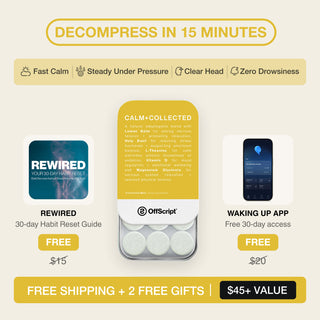
CALM+COLLECTED is a caffeine-free, non-drowsy sublingual mint, designed to be felt in about 15 minutes. Each mint has 200mg L-theanine, 200mg lemon balm, 100mg holy basil, 120mg magnesium glycinate and 20mcg vitamin D.
In a small four-week trial in 30 adults, 200mg of L-theanine a day lowered stress-related symptom scores and improved sleep quality scores compared with placebo (Hidese et al., 2019). An eight-week trial in 100 stressed adults found holy basil extract at 125mg twice daily reduced perceived stress more than placebo (Lopresti et al., 2022). Our holy basil dose is lower than that, so treat it as a supporting ingredient.
It is non habit-forming. The CALM+COLLECTED page for parents shows how parents use it through the day. It is $59 for 24 mints, or $39 on subscription, with a 30-day money-back guarantee. If you are pregnant or breastfeeding, or take medication, check with your doctor first.
A CALMER BASELINE WHILE YOU REBUILD
Caffeine-free L-theanine, lemon balm and holy basil in a mint, felt in about 15 minutes.
SHOP CALM+COLLECTEDKey Takeaways
- Parental burnout is a researched syndrome: exhaustion, emotional distancing from your kids and feeling ineffective as a parent.
- It grows from a long imbalance of stressors over resources, so recovery means lowering the load and adding support.
- At-home parents are exposed by the lack of a shift end, isolation and invisible work. Impossible standards add fuel.
- Working and single parents need plans that fit their setup: trim on both fronts, or build a bench of specific helpers.
- Supplements can support calm, but they do not end burnout. If it looks like depression, see a doctor, and call or text 988 in a crisis.
Explore the Series
- The Mental Load: What It Is and How to Share It
- Tired Mom: Why You Are This Exhausted and What Helps
- The Overstimulated Mom: Why Noise and Touch Hit So Hard
- Time Management for Moms
- Supplements for Burnout: What the Evidence Says
- Holy Basil for Stress
References
- Roskam I, et al. Exhausted Parents: Development and Preliminary Validation of the Parental Burnout Inventory. Front Psychol. 2017. PMID 28232811
- Mikolajczak M, et al. A Theoretical and Clinical Framework for Parental Burnout: The Balance Between Risks and Resources (BR(2)). Front Psychol. 2018. PMID 29946278
- Brianda ME, et al. Hair cortisol concentration as a biomarker of parental burnout. Psychoneuroendocrinology. 2020. PMID 32417622
- Roskam I, et al. Parental Burnout Around the Globe: a 42-Country Study. Affect Sci. 2021. PMID 33758826
- Roskam I, et al. Three reasons why parental burnout is more prevalent in individualistic countries: a mediation study in 36 countries. Soc Psychiatry Psychiatr Epidemiol. 2024. PMID 37195293
- Hidese S, et al. Effects of L-Theanine Administration on Stress-Related Symptoms and Cognitive Functions in Healthy Adults: A Randomized Controlled Trial. Nutrients. 2019. PMID 31623400
- Lopresti AL, et al. A randomized, double-blind, placebo-controlled trial investigating the effects of an Ocimum tenuiflorum (Holy Basil) extract on stress, mood, and sleep in adults experiencing stress. Front Nutr. 2022. PMID 36185698
FAQ
What Are the Signs of Stay at Home Mom Burnout?
Common signs include exhaustion that rest does not touch, feeling on autopilot or emotionally distant with your kids, feeling like a worse parent than before and frequent fantasies of escaping. Small problems start to feel huge. If these last for weeks, it is time to change the load and get support.
How Long Does It Take to Recover From Parental Burnout?
There is no set timeline. Recovery depends on how much your stress and support actually change, so a plan with real help and real rest tends to work faster than willpower alone. If you are not improving after a few months of changes, talk to your doctor or a therapist.
Is Parental Burnout the Same as Depression?
No, though they can overlap. Parental burnout centers on the parenting role, while depression usually affects every area of life. A doctor or therapist can help you tell them apart, and in a crisis you can call or text 988 in the US.
Can Supplements Help With Mom Burnout?
Supplements cannot end burnout. Some calming ingredients, such as L-theanine, have small trials showing lower stress-related symptoms, so they can support you while you rebuild rest and help. If you are pregnant or breastfeeding, check with your doctor first.
How Can Single Parents Avoid Burnout?
Build a bench of specific helpers, like a neighbor for pickup or a grandparent for one evening a week, and ask for exact times. Simplify routines so the kids can run more of them alone. Protect at least one small block of time each week that is only yours.
These statements have not been evaluated by the Food and Drug Administration. This product is not intended to diagnose, treat, cure, or prevent any disease. If you are pregnant or breastfeeding, check with your doctor first.
