





Time management for moms works best when you manage energy and attention, not just minutes: protect a couple of focused blocks, batch the small stuff and put the repeating parts of the day on routine. You will not find more hours, but you can stop losing the ones you have to switching, remembering and recovering.
This guide is for parents of school-age kids, working outside the home or not. If you are in the newborn stage, schedules are mostly fiction for now, and our guide to supplements for new parents is the better companion.
Why Time Management for Moms Is Different
Most productivity advice assumes you control your calendar. Moms run two calendars, often more, and the second one is full of tasks nobody sees: noticing the shoes are too small, remembering picture day, planning dinner around soccer.
That invisible planning is real work. In a survey of 393 partnered US mothers, most said they alone handled organizing the family's schedules, and feeling disproportionately responsible for running the household was linked to lower well-being (Ciciolla and Luthar, 2019). Our guide to the mental load covers how to share it.
Then there are interruptions. Every time you jump from a work email to a school form and back, you pay a toll. In classic lab experiments, switching between tasks cost time compared with sticking with one, and the cost grew as tasks got more complex (Rubinstein et al., 2001). People who habitually juggle many media streams also did worse at filtering out distractions and on a task-switching test (Ophir et al., 2009). The fix is not to stop being interrupted, which is impossible with kids. It is to group similar tasks so you switch less.
If focus has always been a struggle, not just since kids, our guide for the ADHD mom may fit you better.
Time Management for Moms Starts With Energy
An hour at 9am and an hour at 9pm are not the same hour. Notice when your brain is sharpest (for many people it is mid-morning) and guard that window for the work that needs thinking. Put laundry, errands and email in the slumps.
Sleep sets the ceiling. In a well-known lab study, adults limited to six hours a night for two weeks built up steadily worse attention and reaction times, while barely noticing how impaired they had become (Van Dongen et al., 2003). No schedule outruns that. If you are running on empty, start with our guide for the tired mom before you optimize anything else.
Caffeine helps most when it is timed, not constant. Use it before your focus block, not as a drip all day, and stop by early afternoon so it does not eat into sleep.
A Sample Working Mom Schedule
Here is a school-day template for a parent with a flexible or hybrid job. Shift the times to fit your life. The shape matters more than the clock.
| Time | Block | What Happens |
|---|---|---|
| 6:15 | Your 20 minutes | Up before the kids. Water, daylight, today's top three. |
| 6:35 | Launch | Breakfast, bags from the launch pad by the door, out on time. |
| 7:30 | School run | Drop-off. Podcast or quiet, not your inbox. |
| 8:00 | Focus block one | Your hardest task. Phone on Do Not Disturb. |
| 10:00 | Meetings and messages | Batch replies instead of answering as they land. |
| 12:00 | Lunch away from screens | Eat, then a 10-minute walk. |
| 12:45 | Life admin batch | School emails, forms, appointments, orders. All at once. |
| 1:30 | Focus block two | Second priority or meetings. |
| 3:00 | Shutdown | Write tomorrow's top three. Close the laptop. |
| 3:15 | Pickup and activities | Snack, homework, driving. |
| 5:30 | Dinner | Straight from the weekly plan. No deciding. |
| 7:30 | Bedtime routine | Same order every night. |
| 8:30 | Ten-minute reset | Kitchen, bags to the launch pad, then off duty. |
Working a fixed 9 to 5? Keep the bookends (your 20 minutes, the evening reset and one life admin batch at lunch) and fit the focus blocks around your meetings.
At home with younger school-age kids or a preschooler? Nap time or quiet time is your focus block. Treat it as a sprint: pick one thing before it starts and do only that. The dishes can wait until the kids are awake and can help.
A 20-Minute Morning Routine for Busy Moms
The goal is not a perfect morning. It is 20 minutes where the day happens on your terms before it starts happening to you.
- Minutes 0 to 2: A glass of water. Phone stays face down.
- Minutes 2 to 7: Move. Stretch, or step outside for daylight, even in a coat over pajamas.
- Minutes 7 to 12: Get dressed. Clothes picked the night before.
- Minutes 12 to 17: Look at today. Check the calendar, write your top three, choose one thing to drop.
- Minutes 17 to 20: Coffee, tea or a focus mint, in quiet, before the first "Mom!"
Want to build on it? Our peak performance morning protocol goes further. Expect a new routine to take a while to feel automatic. Our piece on how long it takes to build a habit has realistic numbers.
Working Mom Tips That Actually Save Time
Batch Everything Small
One window a day for school emails and forms. One online grocery order a week. One errand loop instead of four trips. Fewer switches, fewer forgotten tabs.
Do a Sunday Reset
Thirty to forty-five minutes, ideally with your partner. Walk through the week's calendar, plan dinners, sign the forms, set out the first two days of clothes and decide who owns which pickups. It makes Monday a lot less dramatic.
Turn Worries Into Plans
Unfinished tasks nag. In a set of lab experiments, open goals caused intrusive thoughts and hurt performance on unrelated tasks, but writing a specific plan for them made those effects go away (Masicampo and Baumeister, 2011). You do not have to do the dentist call now. Write "call dentist, Tuesday 12:45" and let it go.
Decide What to Drop
Time management is mostly subtraction. A few candidates: ironing, homemade everything, replying to group chats in real time, saying yes to every volunteer request, and folding kids' pajamas. Lower the standard on things nobody will remember next month.
Hand Over Whole Jobs
Kids can own their lunch packing, laundry put-away and backpack checks earlier than most of us think. Partners can own entire categories, start to finish. Delegating the task but keeping the remembering does not save you much.
Where Focus Support Fits
We make a focus supplement, so weigh this section accordingly. No mint will give you more hours or replace sleep. What it can do is help you make the most of the focus blocks you protect.
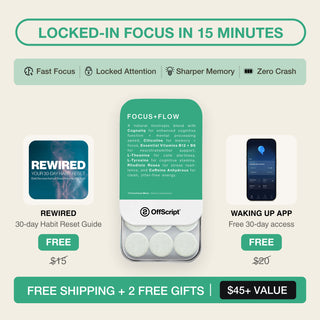
FOCUS+FLOW is a sublingual mint with 100mg caffeine and 150mg L-theanine, plus 100mg L-tyrosine, 100mg rhodiola rosea, 100mg CognatiQ (coffee fruit extract), 18mg citicoline, 5.1mg vitamin B6 and 60mcg vitamin B12. It works in about 15 minutes, so it fits a schedule: one at the start of a focus block, nothing after early afternoon. We built a page on focus support for busy parents if you want the details.
Keep total caffeine under about 400mg a day, the level the FDA cites for most healthy adults, and count your coffee. If you are pregnant or breastfeeding, check with your doctor first. FOCUS+FLOW is non habit-forming, $59 for 24 mints or $39 on subscription, with a 30-day money-back guarantee.
PROTECT YOUR BEST TWO HOURS
100mg caffeine with 150mg L-theanine for calm focus, felt in about 15 minutes.
SHOP FOCUS+FLOWKey Takeaways
- For moms, time management is really energy and attention management. Guard your sharpest hours for thinking work.
- Task switching costs time, so batch small jobs into one or two windows a day.
- A 20-minute morning routine and a 10-minute evening reset do more than a packed schedule.
- A weekly Sunday reset and written plans quiet the mental to-do list.
- Drop what nobody will miss, and hand over whole jobs, not just tasks.
Explore the Series
- The Mental Load, Explained
- ADHD Mom: Why Motherhood Turns Up the Volume and What Helps
- Why You Are a Tired Mom and What Helps
- Stay at Home Mom Burnout
- The Peak Performance Morning Protocol
- How Long Does It Take to Build a Habit?
References
- Ciciolla L, Luthar SS. Invisible household labor and ramifications for adjustment: mothers as captains of households. Sex Roles. 2019. PMID 34177072
- Rubinstein JS, et al. Executive control of cognitive processes in task switching. J Exp Psychol Hum Percept Perform. 2001. PMID 11518143
- Ophir E, et al. Cognitive control in media multitaskers. Proc Natl Acad Sci U S A. 2009. PMID 19706386
- Van Dongen HP, et al. The cumulative cost of additional wakefulness: dose-response effects on neurobehavioral functions and sleep physiology from chronic sleep restriction and total sleep deprivation. Sleep. 2003. PMID 12683469
- Masicampo EJ, Baumeister RF. Consider it done! Plan making can eliminate the cognitive effects of unfulfilled goals. J Pers Soc Psychol. 2011. PMID 21688924
FAQ
How Can a Working Mom Manage Her Time Better?
Protect one or two focus blocks a day for your hardest work, and batch small tasks like school emails and forms into a single window. Put mornings, evenings and weekly planning on routine so they stop needing decisions. Then drop or hand over anything that does not need to be yours.
What Is a Good Morning Routine for Busy Moms?
A short one you will actually keep. Try 20 minutes before the kids wake: water, a few minutes of movement or daylight, getting dressed, and a quick look at the calendar to pick your top three. Prep clothes and bags the night before so the morning has fewer decisions.
How Do Stay-at-Home Moms Manage Their Time?
The same principles apply, with different blocks. Use nap time or quiet time as a focus sprint for one chosen task, batch errands and admin, and keep meals and bedtimes on a predictable routine. A weekly reset helps just as much at home as it does for working moms.
What Should Moms Stop Doing to Save Time?
Start with tasks nobody will remember next month: ironing, replying to group chats in real time, homemade everything and saying yes to every volunteer request. Stop delegating tasks while keeping the remembering. Hand over whole jobs instead.
How Do I Find Time for Myself With Kids?
Schedule it like an appointment, even if it is 20 minutes before everyone wakes up. Protect it the way you would protect a meeting, and trade off with a partner or friend for longer stretches. Small, regular time beats waiting for a free afternoon that never comes.
These statements have not been evaluated by the Food and Drug Administration. This product is not intended to diagnose, treat, cure, or prevent any disease. FOCUS+FLOW contains 100mg caffeine per mint and is intended for adults; if you take prescription medication or are pregnant or breastfeeding, talk to your doctor before use.
