





If you are a tired mom, the cause is usually a stack of real, physical things: years of broken sleep, a brain that never clocks off, almost no recovery time, and sometimes a low iron, B12, vitamin D or thyroid level nobody has checked. It is not a character flaw, and most of it can be improved once you know which pieces apply to you.
This guide is about the school-age years, when the night feeds are long gone and you are somehow still exhausted. Here is why, what to test, and a realistic energy plan for a household that runs on lunchboxes and group chats.
Why You Are Always Tired as a Mom
Your sleep never fully bounced back. A large German study followed 2,541 women through the birth of a child. Sleep duration and sleep satisfaction dropped sharply after birth, and for first-time parents neither had fully recovered six years later, in mothers or fathers (Richter et al., 2019). Six years. That is first grade.
Broken sleep costs as much as short sleep. Kids still wake you: bad dreams, a fever, a 5am question about dinosaurs. In a small lab study of 61 healthy young adults, one night of being woken several times hurt attention and mood about as much as a night cut to four hours in bed. Fatigue went up and vigor went down (Kahn et al., 2014). You can log eight hours in bed and still wake up wrecked.
Your brain is on call all day. Remembering the permission slip, the dentist and the birthday gift is real work, even if nobody sees it. We unpack that in our guide to the mental load. Thinking work tires you out too, and it rarely stops at bedtime.
There is no recovery window. Work, pickup, dinner, homework, bedtime, then the dishes. The hour you finally get to yourself is often the hour you should be asleep, so you stay up scrolling to claim it. Very human. Very tiring.
The Blood Tests Worth Asking About
If you have been exhausted for weeks and rest is not touching it, book a visit and ask for a blood test. Persistent fatigue is a legitimate reason to see your doctor. The usual starting list:
- Iron and ferritin. Ferritin shows your iron stores, and it can run low even when hemoglobin looks normal. In a trial of 198 menstruating women with unexplained fatigue and ferritin under 50 µg/L but no anemia, 12 weeks of iron cut fatigue scores by 47.7%, compared with 28.8% on placebo (Vaucher et al., 2012).
- Vitamin B12. Low B12 can cause tiredness and weakness, and absorption can be affected by some medications and diets (NIH Office of Dietary Supplements).
- Vitamin D. In a placebo-controlled trial of otherwise healthy adults with fatigue and low vitamin D, a single high dose given by the researchers improved fatigue scores more than placebo after four weeks (Nowak et al., 2016).
- Thyroid function. An underactive thyroid is a classic cause of fatigue, and a simple blood test screens for it.
Test before you treat. Iron in particular is not something to megadose on a hunch, because too much causes its own problems. Your results tell you what, if anything, to supplement.
Tired Mom or Burned Out: How to Tell the Difference
Tired gets better with rest. A good weekend, a week of early nights or a few days away, and you feel more like yourself.
Burnout does not lift like that. Researchers who study parental burnout describe overwhelming exhaustion, emotional distance from your kids and a sense that you are no longer effective as a parent (Roskam et al., 2017). If that sounds closer to home, read our guide to stay at home mom burnout, which also covers working and single parents.
If the exhaustion comes with low mood most days, losing interest in things you used to enjoy or feeling hopeless, talk to your doctor or a therapist. In the US, you can call or text 988 any time to reach the Suicide and Crisis Lifeline.
An Energy Plan for a School-Age Household
Nobody is giving you a free afternoon, so this plan works around school hours, not instead of them.
- Anchor your wake time. Get up at roughly the same time every day, weekends included, and get outside light early. The school run counts. A steady wake time makes it easier to fall asleep at night.
- Eat a real breakfast. Coffee and a child's leftover toast crust is not breakfast. Protein and fiber early on make the late morning easier.
- Move after drop-off. A 10-minute walk before you sit down to work or start the house tasks is a reliable mood and energy lift for most people.
- Plan for the afternoon dip. The post-lunch slump is normal biology, and our guide on why the 2pm crash is not a willpower problem explains the options.
- Tag-team the nights. If the kids still wake you, take turns being the parent on call so each adult gets some unbroken nights.
- Protect a real wind-down. Claim your quiet hour earlier in the evening so you do not have to steal it from sleep at midnight.
Want more ideas that do not involve a bigger mug? Our guide on how to get energy without caffeine goes deeper. And if you are reading this in the newborn fog, our guide to supplements for new parents is the companion for that earlier stage.
Caffeine Timing for the Exhausted Mom
Caffeine is a tool, and timing decides whether it helps or backfires. In a study of 400mg of caffeine taken at bedtime, three hours before or six hours before, all three timings disrupted sleep compared with placebo (Drake et al., 2013). The researchers' takeaway was to avoid substantial caffeine for at least six hours before bed.
For a 10pm bedtime, that means your last real caffeine lands around 4pm at the latest. Earlier is better if you are sensitive. Total intake matters too: the FDA cites 400mg a day as an amount not generally linked to negative effects in most healthy adults (FDA). Count every coffee, tea, soda and supplement toward that number.
Where Focus Support Fits
Weigh this section accordingly, because we make the product. Nothing in a mint replaces sleep, iron or a doctor's visit. If your tests come back low, treat that first.
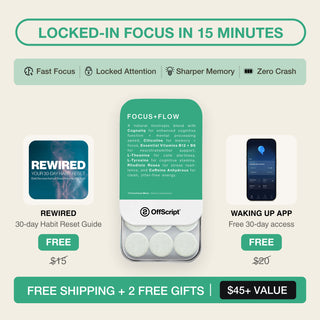
Where FOCUS+FLOW fits is the part of the day when you need to think clearly and the coffee pot has already let you down. Each sublingual mint contains 100mg caffeine, 150mg L-theanine, 100mg CognatiQ (coffee fruit extract), 100mg L-tyrosine, 100mg rhodiola rosea, 18mg citicoline, 60mcg vitamin B12 and 5.1mg vitamin B6.
The caffeine and L-theanine pairing is the core. In small crossover trials, caffeine combined with L-theanine improved performance on attention tasks and self-rated alertness compared with placebo (Owen et al., 2008; Haskell et al., 2008). Rhodiola has a trial in 60 adults with stress-related fatigue, where 576mg a day for four weeks reduced fatigue compared with placebo (Olsson et al., 2009). Our 100mg is well below that dose, so it is a supporting ingredient, not the headline.
It is felt in about 15 minutes and is non habit-forming. Take it in the morning or early afternoon, not after about 2pm, and count it toward your daily caffeine. The FOCUS+FLOW page for parents shows how it fits a school day. It is $59 for 24 mints, or $39 on subscription, with a 30-day money-back guarantee. If you are pregnant or breastfeeding, check with your doctor first.
STEADY ENERGY FROM DROP-OFF TO DINNER
100mg caffeine with 150mg L-theanine in a mint, felt in about 15 minutes.
SHOP FOCUS+FLOWKey Takeaways
- Mom tiredness has physical causes: sleep that never fully recovered, frequent night wakings, a nonstop mental load and no recovery time.
- Persistent exhaustion is worth a blood test. Ask about iron and ferritin, B12, vitamin D and thyroid function.
- Tired improves with rest. Burnout adds emotional distance and a sense of not coping as a parent, and it needs a bigger plan.
- Anchor your wake time, move after drop-off and keep caffeine at least six hours away from bedtime.
- Focus support can help on demanding days. It does not replace sleep or treating a real deficiency.
Explore the Series
- The Mental Load: What It Is and How to Share It
- Stay at Home Mom Burnout: Signs and a Recovery Plan
- The Overstimulated Mom: Why Noise and Touch Hit So Hard
- Time Management for Moms
- How to Get Energy Without Caffeine
- The 2pm Crash Is Not a Willpower Problem
References
- Richter D, et al. Long-term effects of pregnancy and childbirth on sleep satisfaction and duration of first-time and experienced mothers and fathers. Sleep. 2019. PMID 30649536
- Kahn M, et al. Effects of one night of induced night-wakings versus sleep restriction on sustained attention and mood: a pilot study. Sleep Med. 2014. PMID 24891081
- Vaucher P, et al. Effect of iron supplementation on fatigue in nonanemic menstruating women with low ferritin: a randomized controlled trial. CMAJ. 2012. PMID 22777991
- Nowak A, et al. Effect of vitamin D3 on self-perceived fatigue: A double-blind randomized placebo-controlled trial. Medicine (Baltimore). 2016. PMID 28033244
- Drake C, et al. Caffeine effects on sleep taken 0, 3, or 6 hours before going to bed. J Clin Sleep Med. 2013. PMID 24235903
- Owen GN, et al. The combined effects of L-theanine and caffeine on cognitive performance and mood. Nutr Neurosci. 2008. PMID 18681988
- Haskell CF, et al. The effects of L-theanine, caffeine and their combination on cognition and mood. Biol Psychol. 2008. PMID 18006208
- Roskam I, et al. Exhausted Parents: Development and Preliminary Validation of the Parental Burnout Inventory. Front Psychol. 2017. PMID 28232811
- Olsson EM, et al. A randomised, double-blind, placebo-controlled, parallel-group study of the standardised extract shr-5 of the roots of Rhodiola rosea in the treatment of subjects with stress-related fatigue. Planta Med. 2009. PMID 19016404
- NIH Office of Dietary Supplements. Vitamin B12 Fact Sheet for Consumers. ods.od.nih.gov
- US Food and Drug Administration. Spilling the Beans: How Much Caffeine Is Too Much? fda.gov
FAQ
Why Am I Always Tired as a Mom?
Usually it is a combination: sleep that never fully recovered after having kids, night wakings that fragment rest, a constant mental load and almost no downtime. Low iron, B12, vitamin D or thyroid function can add to it. If rest does not help after a few weeks, ask your doctor for a blood test.
Which Blood Tests Should a Tired Mom Get?
A common starting point is a full blood count with ferritin, vitamin B12, vitamin D and thyroid function. Your doctor may add others based on your symptoms and history. Test first, then supplement based on the results.
Is It Normal to Still Be Exhausted When Your Kids Are in School?
It is common. One large study found that parents' sleep had not fully recovered six years after their first child was born. Common does not mean you have to accept it, though, so check the basics and look at your sleep, caffeine timing and workload.
How Much Caffeine Is Safe for a Tired Mom?
The FDA cites 400mg a day as an amount not generally linked to negative effects for most healthy adults. Keep substantial caffeine at least six hours away from bedtime so it does not cost you sleep. If you are pregnant or breastfeeding, check with your doctor first.
How Can I Get More Energy as a Mom Without More Coffee?
Anchor your wake time, get outside light in the morning, eat a real breakfast and take a short walk after drop-off. Share night duty if the kids still wake you. Lightening the mental load helps too, because constant planning is tiring in its own right.
These statements have not been evaluated by the Food and Drug Administration. This product is not intended to diagnose, treat, cure, or prevent any disease. FOCUS+FLOW contains 100mg caffeine per mint; if you are pregnant or breastfeeding, check with your doctor first.
