




This comparison usually gets framed as a replacement question, which is the wrong frame. Almost nobody quits coffee for pouches. What actually happens is that pouches fill the gaps where coffee is impractical, + the useful question is which gaps those are.
Here is the honest version, including the parts that do not favour the newer format.
Speed Of Onset
Pouches are faster, + the mechanism is well understood. Caffeine absorbed through the lining of the mouth enters circulation without first passing through the liver. Reviews of buccal + sublingual delivery describe this route as bypassing hepatic first-pass metabolism.
The closest hard data comes from caffeinated gum, which uses the same route: peak plasma concentration in roughly 44 to 80 minutes versus 84 to 120 minutes for capsules.
Coffee sits between the two. It is a liquid, so it empties from the stomach faster than a capsule, but it still takes the gut route. Most people feel it within 20 to 45 minutes, with peak levels later.
So: pouches are quickest, coffee is respectable, capsules are slowest. The gap between a pouch + a coffee is real but smaller than the marketing suggests.
Knowing What You Took
This is where pouches win properly + it rarely gets discussed.
A pouch says 100mg on the tin. A home-brewed cup of coffee is genuinely unpredictable, ranging from roughly 70mg to 180mg depending on the bean, the roast, the grind, the brew method + how heavy-handed you were that morning. Coffee shop drinks vary more still, because a "large" is not a standardised unit.
If you are sensitive to caffeine, or you are trying to keep a consistent dose before training or a long drive, that variability is the actual problem. A measured dose solves it.
What Coffee Has That A Pouch Does Not
Three things, + they are easy to undervalue until they are gone.
The compounds that are not caffeine. Coffee is a chemically busy drink. Isolated caffeine is one molecule. Whether the rest matters to you is a reasonable debate, but a pouch is definitionally narrower.
The ritual. This sounds soft + is not. The act of making coffee, walking to get it, or sitting with it creates a break in the day. A pouch delivers a stimulant with no pause attached. People who fully switch often report the caffeine still works + the day feels worse, + this is usually why.
A built-in stopping point. A cup ends. Finishing it is a natural checkpoint where having another is a conscious decision. This is the single biggest behavioural advantage coffee holds, + the reason it matters is in the next section.
The Overshoot Problem
Pouches are discreet, need no preparation, leave nothing on the desk + make no noise. Every one of those selling points is also a removed cue.
At 100mg a pouch, four across a working day is 400mg, which is the ceiling the FDA generally cites for healthy adults. Add a morning coffee + you are past it, having never felt like you consumed much of anything. This is the most common way people end up jittery, anxious or wide awake at midnight on this format, + it is not a reaction to the format itself. It is arithmetic nobody did.
Where Each One Belongs
Pouches or mints make sense: driving, flights, the gym, back-to-back meetings, early starts before anywhere is open, anywhere without a kettle, + anywhere a cup would be conspicuous or unwelcome.
Coffee makes sense: at a desk, at home, when you want the break as much as the stimulant, + when the social part is the point.
Most people who use both end up with coffee as the morning anchor + a measured format for the afternoon, which has the useful side effect of making the second dose a deliberate one.
The Afternoon Question
Worth naming, because it affects both. Caffeine has a long tail. Taken late enough it will still be measurably present at bedtime, + the effect on sleep is often invisible to the person experiencing it, who reports falling asleep fine while sleeping worse.
The fix is not necessarily quitting. Moving the last dose earlier usually does more than cutting the total, + a measured format makes that easier to manage than a cup of unknown strength.
What We Make + Why It Is Relevant
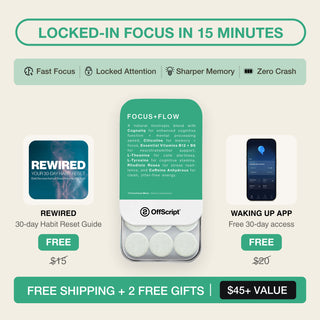
Straight: OffScript does not make pouches or coffee. FOCUS+FLOW is a fast-dissolving mint, which uses the same oral-mucosal route a pouch does without a sachet to hold in your lip + without part of the dose staying behind in material you throw away.
The more important difference is what fits. A pouch has almost no room, which is why the category is caffeine with a vitamin garnish. Caffeine alone is blunt. The most replicated finding in this literature is caffeine paired with L-theanine, which improves accuracy on demanding attention-switching tasks + reduces susceptibility to distraction, with EEG work showing alpha-band changes consistent with sustained attention. FOCUS+FLOW carries 150mg of L-theanine against 100mg of caffeine for exactly that reason.
Patented coffee-fruit extract, clinically studied to support BDNF.
Calm, focused attention without the jitters.
Dopamine precursor for drive + focus under pressure.
Adaptogen that supports mental stamina under stress.
Clean, measured energy, smoothed by L-Theanine.
Raw material for acetylcholine, the memory + learning neurotransmitter.
Supports neurotransmitter production.
Supports cellular energy.
Key Takeaways
- Pouches reach you faster because oral absorption bypasses first-pass liver metabolism. Coffee sits between a pouch + a capsule.
- Faster is not stronger. Total absorption over time is broadly comparable.
- Pouches win decisively on dose precision. A home-brewed cup ranges from about 70mg to 180mg.
- Coffee carries compounds beyond caffeine, provides a break in the day, + ends, which is a real advantage.
- The pouch format removes every stopping cue, which is how people overshoot without noticing.
- Timing matters more than total. Moving the last dose earlier usually beats cutting the amount.
Explore The Series
- Caffeine Pouches: Do They Actually Work?
- Caffeine Pouches vs Mints: Which Format Actually Wins?
- Caffeine Mints vs Coffee
- Energy Pouches: What They Are + What To Look For
- Does Caffeine Raise Cortisol?
- Clean Energy Without The Crash
References
- Kamimori GH, et al. The rate of absorption and relative bioavailability of caffeine administered in chewing gum versus capsules to normal healthy volunteers. International Journal of Pharmaceutics. 2002. PubMed
- Wickham KA, Spriet LL. Administration of Caffeine in Alternate Forms. Sports Medicine. 2018. PMC
- Sublingual and Buccal Delivery: A Historical and Scientific Prescriptive. Pharmaceutics. 2025. MDPI
- Owen GN, et al. The combined effects of L-theanine and caffeine on cognitive performance and mood. Nutritional Neuroscience. 2008. PubMed
- Kelly SP, et al. L-theanine and caffeine in combination affect human cognition as evidenced by oscillatory alpha-band activity and attention task performance. Journal of Nutrition. 2008. PubMed
FAQ
Are caffeine pouches better than coffee?
Better at different things. Pouches deliver faster, tell you exactly how many milligrams you are taking, and work anywhere without a kettle. Coffee carries compounds beyond caffeine, provides a genuine break in the day, and has a built-in stopping point because a cup ends. Most people who use both keep coffee as the morning anchor and use a measured format later in the day.
How much caffeine is in a cup of coffee compared with a pouch?
A pouch is typically 50mg to 100mg and stated on the tin. A home-brewed cup of coffee ranges from roughly 70mg to 180mg depending on bean, roast, grind and brew method, and coffee shop drinks vary more because sizes are not standardised. If consistent dosing matters to you, that variability is the main argument for a measured format.
Do caffeine pouches hit faster than coffee?
Yes, though the gap is smaller than marketing suggests. Caffeine absorbed through the lining of the mouth bypasses first-pass liver metabolism, and gum research using that same route found peak plasma concentration at roughly 44 to 80 minutes versus 84 to 120 for capsules. Coffee is a liquid so it moves through the stomach faster than a capsule, placing it between the two.
Can you use caffeine pouches and drink coffee?
You can, but add up the total. At 100mg a pouch, four across a day reaches 400mg, the ceiling the FDA generally cites for healthy adults, before any coffee is counted. The pouch format gives you none of the natural stopping cues a cup provides, which is why people overshoot without realising.
Will caffeine pouches affect my sleep?
They can, like any caffeine. The compound has a long tail and taken late enough will still be measurably present at bedtime, often degrading sleep quality in people who report falling asleep normally. Moving your last dose earlier usually helps more than reducing the daily total, and a measured format makes that easier to manage than a cup of unknown strength.
These statements have not been evaluated by the Food and Drug Administration. This product is not intended to diagnose, treat, cure, or prevent any disease. This article is educational and is not medical advice.