




Ashwagandha might be the most oversold herb on the internet, which is a shame, because the real evidence is genuinely interesting. So here is the honest version of the ashwagandha-and-cognition story: what the trials actually show, what they do not, + why OffScript deliberately chose different adaptogens for its own formulas. Yes, you read that right: ashwagandha is not in any OffScript product, + by the end of this article you will know exactly why. If you are shopping the category rather than the ingredient, start with cortisol supplements.
What Ashwagandha Genuinely Does Well
Ashwagandha (Withania somnifera) is an Ayurvedic adaptogen whose active compounds, withanolides, act on the HPA axis, the system that governs your stress response, alongside GABA-related signaling. Its best evidence is squarely on the stress side, + it is strong by supplement standards.
In a randomized, double-blind, placebo-controlled study of 64 chronically stressed adults, a high-concentration root extract at 300mg twice daily for 60 days produced roughly a 28% reduction in serum cortisol versus placebo, alongside significantly lower scores on standardized stress scales (Chandrasekhar et al., 2012). A later randomized trial found significantly greater reductions in morning cortisol than placebo, attributing the effect to an attenuating action on the HPA axis (Salve et al., 2019). Several trials also report improved sleep quality.
That is a real resume: the strongest cortisol data of any adaptogen, plus sleep support. If your problem is anxious tension + poor sleep, ashwagandha is a legitimate, evidence-supported tool, + we will say that plainly even though we do not sell it.
The Cognition Question, Answered Honestly
Here is where most articles overreach. Does ashwagandha directly enhance cognitive performance, focus, memory, processing speed, the way a nootropic is supposed to?
The fair reading of the literature: the direct cognitive-enhancement evidence is thin + mixed. A handful of small trials report improvements on some memory or reaction measures, but the studies are few, the populations vary, + the effects are inconsistent. What is better supported is an indirect route: chronically elevated cortisol degrades attention + memory, so in chronically stressed people, lowering the stress load can clear cognitive room. That is real, but it is a stress mechanism, not a focus mechanism.
One more line that needs saying because other articles imply otherwise: no supplement, ashwagandha included, has evidence comparable to prescription medication for any diagnosed condition, + nothing here is medical advice. Supplements support healthy systems; they do not treat disorders.
Why Ashwagandha Is Not In OffScript Formulas
This is a deliberate formulation choice, not an oversight, + the reasoning is the useful part.
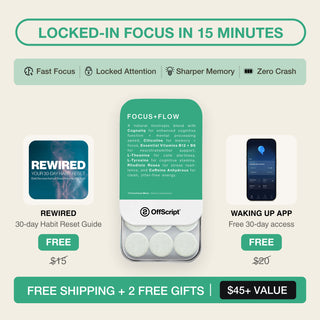
For the focus formula, we chose Rhodiola Rosea instead. Rhodiola is the only adaptogen with controlled human trials measuring stress + mental performance at the same time: a standardized extract improved a composite mental-performance index by roughly 20% in physicians on night duty (Darbinyan et al., 2000), + a 28-day randomized trial in stress-fatigued adults reported reduced burnout, improved attention + a measurably lower cortisol response to awakening (Olsson et al., 2009). A focus product needs an adaptogen that protects output, not one that quiets the day. That is why FOCUS+FLOW carries 100mg of Rhodiola alongside its caffeine + L-Theanine core, + zero ashwagandha.
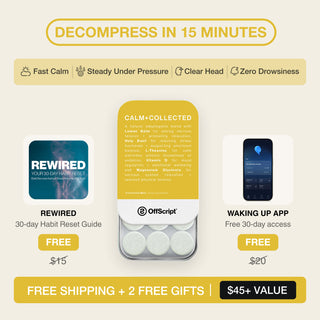
For the calm formula, we chose Holy Basil + Lemon Balm instead. Holy basil is an adaptogen with randomized placebo-controlled evidence on stress outcomes (Lopresti et al., 2022) + a favorable safety review (Jamshidi + Cohen, 2017); lemon balm works on GABA turnover. Both fit a daytime calm product: they promote composure without the sedating drift some people report from ashwagandha, + with fewer interaction flags. That is the blend inside CALM+COLLECTED: Lemon Balm 200mg, L-Theanine 200mg, Holy Basil 100mg, Magnesium Glycinate 120mg, Vitamin D 20mcg. Every dose printed. No ashwagandha.
Ashwagandha vs Rhodiola vs Holy Basil: Pick By Job
| Ashwagandha | Rhodiola Rosea | Holy Basil | |
|---|---|---|---|
| Best-evidenced job | Cortisol + sleep | Stress + mental performance together | Everyday stress load |
| Cognitive-performance trials | Thin, mixed | Yes, under fatigue | No |
| Daytime feel | Can be quieting | Neutral to mildly activating | Neutral |
| Best timing | Evening | Morning | Flexible |
| In an OffScript formula? | No | FOCUS+FLOW, 100mg | CALM+COLLECTED, 100mg |
The pattern: match the adaptogen to the job. If cortisol + sleep are your problem, ashwagandha from any reputable brand is a fine choice, taken in the evening. If you need stress resilience that protects your thinking, rhodiola has the trials. If you want daytime composure without drowsiness, holy basil + lemon balm are the lane. The full ranked breakdown lives in Best Adaptogens for Stress and Focus, Ranked.
If You Do Take Ashwagandha
Practical honesty for the people who came here to use it, not to be sold something else. Research dosing clusters around 300 to 600mg per day of a standardized root extract, with effects on cortisol + stress scales measured over 4 to 8 weeks; this is a multi-week regulator, not a same-day pill. Evening timing suits its quieting profile. Safety notes worth taking seriously: it is a nightshade (allergy relevance), it can interact with thyroid medication + sedatives, + it is not advised during pregnancy or when trying to conceive. On any prescription, ask your clinician before adding it.
CALM UNDER PRESSURE
Daytime calm built on Holy Basil, Lemon Balm + L-Theanine. Every dose printed.
SHOP CALM+COLLECTEDKey Takeaways
- Ashwagandha's real strength is cortisol + sleep: roughly a 28% serum cortisol reduction in a 60-day placebo-controlled trial.
- Direct cognitive-enhancement evidence is thin + mixed; where thinking improves, it is mostly downstream of lowered stress.
- No OffScript product contains ashwagandha. FOCUS+FLOW uses Rhodiola (the adaptogen with dual stress + performance trials); CALM+COLLECTED uses Holy Basil + Lemon Balm for daytime calm without drowsiness.
- If you take ashwagandha: 300-600mg standardized root extract, evenings, judged over 4-8 weeks, with real interaction cautions.
- No supplement is comparable to prescription treatment for a diagnosed condition, + anyone claiming otherwise is overselling.
Explore The Series
- Best Adaptogens for Stress and Focus, Ranked
- Ashwagandha for Stress and Anxiety: What the Research Actually Says
- Rhodiola Rosea for Mental Fatigue: What the Science Says
- Holy Basil (Tulsi): The Adaptogen for Stress Resilience
- Lemon Balm: The Calming Herb With Real Research
References
- Chandrasekhar K, Kapoor J, Anishetty S. A prospective, randomized double-blind, placebo-controlled study of safety and efficacy of a high-concentration full-spectrum extract of ashwagandha root in reducing stress and anxiety in adults. Indian J Psychol Med. 2012;34(3):255-262. Journal
- Salve J, Pate S, Debnath K, Langade D. Adaptogenic and anxiolytic effects of ashwagandha root extract in healthy adults: a double-blind, randomized, placebo-controlled clinical study. Cureus. 2019;11(12):e6466. PMC
- Darbinyan V, Kteyan A, Panossian A, et al. Rhodiola rosea in stress induced fatigue. Phytomedicine. 2000;7(5):365-371. PubMed
- Olsson EM, von Schéele B, Panossian AG. A randomised, double-blind, placebo-controlled study of the standardised extract SHR-5 of Rhodiola rosea in subjects with stress-related fatigue. Planta Med. 2009;75(2):105-112. PubMed
- Lopresti AL, Smith SJ, Metse AP, Drummond PD. A randomized, double-blind, placebo-controlled trial investigating the effects of an Ocimum tenuiflorum (holy basil) extract on stress. Front Nutr. 2022;9:965130. PubMed
- Jamshidi N, Cohen MM. The clinical efficacy and safety of tulsi in humans: a systematic review of the literature. Evid Based Complement Alternat Med. 2017;2017:9217567. PMC
FAQ
Does ashwagandha improve cognitive performance?
Indirectly at best. Its strong evidence is for lowering cortisol and improving stress + sleep measures; direct cognitive-enhancement trials are few and mixed. In chronically stressed people, thinking often improves as the stress load drops, but that is a stress mechanism, not a nootropic one. For an adaptogen with actual mental-performance trials, rhodiola is the better-evidenced pick.
Is ashwagandha in FOCUS+FLOW or CALM+COLLECTED?
No. No OffScript product contains ashwagandha. FOCUS+FLOW uses Rhodiola Rosea (100mg) because it pairs stress resilience with measured mental-performance outcomes. CALM+COLLECTED uses Holy Basil (100mg), Lemon Balm (200mg), L-Theanine (200mg), Magnesium Glycinate (120mg) and Vitamin D (20mcg) for daytime calm without drowsiness.
What is ashwagandha actually good for?
Stress and sleep. The standout data: roughly a 28% reduction in serum cortisol versus placebo over 60 days at 300mg twice daily, alongside lower perceived-stress scores, plus sleep-quality improvements in several trials. If anxious tension and poor sleep are your problems, it is a legitimate evening tool.
Ashwagandha or rhodiola: which should I take?
Match the job. Ashwagandha for cortisol, evening wind-down and sleep. Rhodiola for holding mental output steady under stress and fatigue, taken in the morning. They are not interchangeable: one quiets the system, the other protects performance while the system is loaded.
Is ashwagandha safe to take daily?
Generally well tolerated in trials at studied doses over 8 to 12 weeks, but it is not risk-free: it is a nightshade, it can interact with thyroid medication and sedatives, and it is not advised in pregnancy or when trying to conceive. Long-term daily use beyond trial durations is less studied. If you take any prescription, ask your clinician first.
These statements have not been evaluated by the Food and Drug Administration. This product is not intended to diagnose, treat, cure, or prevent any disease. This article is educational and is not medical advice.