




Search "huberman supplement stack" and you'll find dozens of pages promising to hand you a shopping list. Twelve bottles, morning column, evening column, buy links down the right rail. It's one of the most copied artifacts in the performance space — and it's almost always copied wrong, because people copy the list instead of the reasoning that produced it.
The list is the least interesting part. The reasoning is where the value sits, and reasoning is portable — it works whether you take eight things or two. So here's an honest audit of which principles behind the popular performance-stack approach survive scrutiny, and which have become cargo cult.
Principle 1: Foundation First, Supplements Last
This is the principle most consistently repeated in serious performance circles and most consistently ignored by the people repeating it. Sleep, morning light, movement, food — then, maybe, a capsule.
It survives scrutiny easily, because the effect sizes aren't close. A systematic review of endurance training found that regular aerobic exercise raises brain-derived neurotrophic factor, the protein central to neuronal growth + plasticity (Mrówczyński, 2019). No pill in this category competes with a consistent training habit on that axis. Sleep tells the same story from the other direction — the returns on protecting it dwarf anything you can stack on top of a broken one.
Morning light sits in the same tier — well-established circadian biology, ten minutes, no cost. Light early in the day anchors your internal clock, which shapes when you feel alert + when you feel tired.
Here's the awkward part. Foundation-first can't be shipped, which is why so much stack content skips straight to the bottles. If you're choosing between fixing your sleep and buying a nootropic, fix your sleep.
Principle 2: Single Ingredients At Studied Doses
This one holds up completely, and it's the sharpest tool in the whole approach.
A "proprietary blend" is a legal construction that lets a brand list twelve impressive ingredients without telling you the amount of any of them. It can be 95% the cheapest one. You can't check it against a study, because studies dose specific compounds at specific amounts, and the label has hidden exactly that number.
Naming each ingredient with its dose is what makes a formula falsifiable. Look up the trial, compare the amount, decide whether the dose is meaningful or decorative. That's the difference between a supplement you can reason about + one you have to trust.
Principle 3: Know The Mechanism Before You Swallow It
Mechanism-first thinking is the habit of asking why something should work before asking whether it does. It won't tell you a compound is effective — plenty of elegant mechanisms fail in humans — but it's a fast, cheap filter that removes most of the junk.
Caffeine is the cleanest example. It doesn't manufacture energy. It's an adenosine receptor antagonist: adenosine accumulates through your waking hours and signals fatigue, and caffeine occupies the receptors so the signal doesn't land (Fredholm et al., 1999). Once you know that, the rest follows. The fatigue is deferred, not deleted. The crash isn't a mystery. Using caffeine to paper over sleep debt is borrowing at a rate you'll notice.
Run that test on anything you're considering. If the marketing can't tell you what the compound does at the level of a receptor, a pathway, or a precursor — and offers only adjectives — you've learned something.
Principle 4: Timing And Context Do More Than Dose
This is the principle that separates people who understand the material from people reciting it, and it's where most copied stacks fall apart.
Take L-tyrosine. It's a dopamine precursor, frequently sold as a general lift. The evidence doesn't say that. A review found tyrosine's benefit appears specifically in populations under stress or high cognitive demand — situations where neurotransmitter turnover is already elevated (Jongkees et al., 2015). Take it on a quiet Sunday and expect very little. Take it before a high-pressure block of work and the context matches the research. Same molecule, same dose, different answer.
Caffeine timing is the other half. In a controlled study, a 400mg dose taken even six hours before bed measurably disrupted sleep (Drake et al., 2013). That's a specific dose at specific intervals, not a licence to invent a rule about some magic number of hours. The honest takeaway is simply that afternoon caffeine reaches further into your night than it feels like it does, and sleep is the foundation you were told to protect first.
Amount matters less than people assume, past a point. European food-safety assessors concluded single doses up to 200mg, and up to 400mg across a day, are safe for healthy adults (EFSA, 2015). Beyond that you're not buying focus. You're buying jitter.
Principle 5: Stack For Synergy, Not For Length
The strongest case for combining anything is when two compounds do something together that neither does alone. L-theanine + caffeine is the most replicated example in this whole category.
L-theanine alone increases alpha-wave activity, the electrical signature of relaxed alertness (Nobre et al., 2008). Paired with caffeine, it improved attention + reduced tiredness in healthy adults (Haskell et al., 2008), and a later trial found the combination outperformed either compound taken alone (Kahathuduwa et al., 2017). Caffeine supplies the drive; theanine files down the edge.
That's what a stack is for. Two things chosen because they interact — not eleven things chosen because each had a good week online.
What's Actually Oversold
Three things, honestly.
The number of bottles. Beyond a small handful of compounds with real mechanisms, extra pills mostly add cost, complexity + interactions nobody has studied. A twelve-item stack isn't twelve times better than a three-item one.
Novelty over adherence. The common failure isn't picking the wrong compound. It's taking the right one inconsistently for nine days, feeling nothing, then moving on to whatever's trending. Almost every study you'd cite ran for weeks. Chasing the new thing guarantees you never run the experiment.
The idea that the stack is the intervention. It's the last five percent, layered on sleep, light, movement + a day designed so focus doesn't depend on brute force.
What This Leaves You With
Take the principles seriously rather than the shopping list and the conclusion is unglamorous: most people don't need a cabinet. They need their foundations handled, plus two or three compounds with mechanisms behind them, taken consistently, in the context the research actually studied.
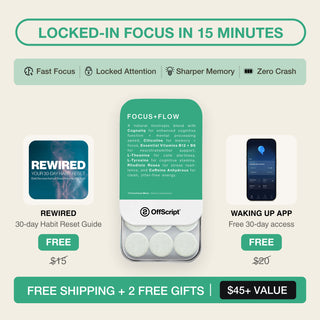
That's the logic FOCUS+FLOW is built on — a short list, disclosed doses, nothing hiding in a blend.
Patented coffee-fruit extract, clinically studied to support BDNF.
Calm, focused attention without the jitters.
Dopamine precursor for drive + focus under pressure.
Adaptogen that supports mental stamina under stress.
Clean, measured energy — smoothed by L-Theanine.
Citicoline-sourced choline; raw material for acetylcholine, the memory + learning neurotransmitter.
Supports neurotransmitter production.
Supports cellular energy.
The coffee fruit extract has been studied for its effect on plasma BDNF (Reyes-Izquierdo et al., 2013), citicoline for attentional performance in healthy adults (McGlade et al., 2012), and rhodiola has controlled-trial evidence for stress-induced mental fatigue (Darbinyan et al., 2000). Modest claims, real mechanisms, published doses.
FOCUS ON COMMAND
Eight ingredients, every dose printed. Try it against your own baseline. 12 mints per tin, 2 tins per order.
SHOP FOCUS+FLOWKey Takeaways
- Copying a stack ingredient-by-ingredient misses the point. The reasoning transfers; the shopping list doesn't.
- Foundation first is the principle that holds up best + gets skipped most. Exercise raises BDNF; no pill in this category competes with that.
- Disclosed single-ingredient doses are what make a formula checkable against research. Proprietary blends make that impossible by design.
- Context beats dose. Tyrosine's evidence sits under stress or cognitive load specifically, and caffeine taken even six hours before bed measurably disrupts sleep.
- Stack for synergy, not length — theanine + caffeine is the best-replicated pairing in the category. Consistency matters more than novelty.
Explore The Series
- L-Theanine and Caffeine: The Perfect Natural Focus Stack
- How to Stack Nootropics for Maximum Focus
- The peak performance morning protocol
References
- Mrówczyński W. Health Benefits of Endurance Training: Implications of the Brain-Derived Neurotrophic Factor—A Systematic Review. Neural Plast. 2019;2019:5413067. PubMed
- Fredholm BB, Bättig K, Holmén J, Nehlig A, Zvartau EE. Actions of caffeine in the brain with special reference to factors that contribute to its widespread use. Pharmacol Rev. 1999;51(1):83-133. PubMed
- Jongkees BJ, Hommel B, Kühn S, Colzato LS. Effect of tyrosine supplementation on clinical and healthy populations under stress or cognitive demands—A review. J Psychiatr Res. 2015;70:50-57. PubMed
- Drake C, Roehrs T, Shambroom J, Roth T. Caffeine effects on sleep taken 0, 3, or 6 hours before going to bed. J Clin Sleep Med. 2013;9(11):1195-1200. PubMed
- EFSA Panel on Dietetic Products, Nutrition and Allergies. Scientific Opinion on the safety of caffeine. EFSA Journal. 2015;13(5):4102. DOI
- Nobre AC, Rao A, Owen GN. L-theanine, a natural constituent in tea, and its effect on mental state. Asia Pac J Clin Nutr. 2008;17 Suppl 1:167-168. PubMed
- Haskell CF, Kennedy DO, Milne AL, Wesnes KA, Scholey AB. The effects of L-theanine, caffeine and their combination on cognition and mood. Biol Psychol. 2008;77(2):113-122. PubMed
- Kahathuduwa CN, Dassanayake TL, Amarakoon AMT, Weerasinghe VS. Acute effects of theanine, caffeine and theanine-caffeine combination on attention. Nutr Neurosci. 2017;20(6):369-377. PubMed
- Reyes-Izquierdo T, Nemzer B, Shu C, et al. Modulatory effect of coffee fruit extract on plasma levels of brain-derived neurotrophic factor in healthy subjects. Br J Nutr. 2013;110(3):420-425. PubMed
- McGlade E, Locatelli A, Hardy J, et al. Improved attentional performance following citicoline administration in healthy adult women. Food Nutr Sci. 2012;3(6):769-773.
- Darbinyan V, Kteyan A, Panossian A, et al. Rhodiola rosea in stress induced fatigue. Phytomedicine. 2000;7(5):365-371. PubMed
FAQ
Is OffScript connected to Andrew Huberman or the Huberman Lab podcast?
No. OffScript has no affiliation, sponsorship, endorsement, or relationship of any kind with Andrew Huberman or the Huberman Lab podcast. This article is independent commentary on principles that circulate publicly in the performance and nootropics space. Nothing here represents his views or anyone else's.
Why does copying someone else's supplement stack usually disappoint people?
Because a stack is downstream of a person's specific goals, schedule, training load, and existing habits. Copy the list without the reasoning and you inherit choices made for a context that isn't yours — often while skipping the sleep, light, and movement work that produces most of the effect in the first place.
How many supplements should someone actually take for focus?
Fewer than most stack guides suggest. Past a small number of compounds with clear mechanisms and disclosed doses, you're mostly adding cost and untested interactions. Two or three things taken consistently beats a dozen taken sporadically, because the research that justifies any of them ran for weeks, not days.
What does a proprietary blend actually hide?
The amount of every ingredient inside it. A blend can list ten impressive compounds under one combined number, which means the formula could be almost entirely the cheapest one. Without per-ingredient doses you can't compare anything to a published study, so the label can't be verified even in principle.
When is the latest I should take caffeine?
Earlier than feels necessary. A controlled study found a 400mg dose taken even six hours before bed measurably disrupted sleep. There's no universal cutoff hour — sensitivity varies — but if you're protecting sleep as your foundation, front-load caffeine into the first half of your day.