




We should say at the top that we do not make pouches, + that we think the people who do have built something genuinely clever. Taking a format most of the world associates with nicotine + turning it into a clean, measured caffeine delivery system was a good idea executed well. The category deserves more credit than it usually gets from supplement brands, who tend to dismiss anything they did not think of first.
So this is not a takedown. It is a guide to choosing well, written by people who went a different direction + will explain why at the end.
How The Category Breaks Down
Rather than a ranking, here is the honest shape of the market. Most products sit in one of three positions.
The low-dose, coffee-forward pouches. Grinds is the brand that effectively created this lane, built around actual coffee grounds + a deliberately modest caffeine load. The pitch is a habit replacement rather than a stimulant hit, + it works for people who want something to do with their mouth more than they want to be wired. If you are caffeine sensitive, this is the corner of the market to start in.
The high-dose energy pouches. Brands like FRE, Mojo + Kick compete on strength, generally landing somewhere between two thirds of a coffee + a full strong cup per pouch. This is the lane for pre-workout, long drives + early shifts. It is also the lane where losing count gets expensive, which we will come back to.
The focus-blend pouches. A smaller group, including Nectr's focus line + Cyclone Pods, add things beyond caffeine: citicoline, guarana, adaptogens. This is the most interesting corner of the category because it is the only one trying to solve the problem caffeine alone does not solve. It is also the corner where the dose-ceiling problem bites hardest, for reasons of pure physics.
The Five Criteria That Actually Matter
1. Caffeine stated in milligrams, per pouch
Not per tin, not inside a proprietary blend. If a brand will not print a number, that is the answer to your question. The best products in this category are all completely upfront about the dose, which is genuinely to their credit + is one of the things the category does better than the energy drink aisle.
2. Whether anything is managing the caffeine
Caffeine on its own is a blunt tool. It raises arousal, + arousal is not the same as focus. The single most replicated finding in this literature is that caffeine paired with L-theanine improves accuracy on demanding attention-switching tasks + reduces susceptibility to distraction, with EEG work showing alpha-band changes consistent with sustained attention.
B vitamins do not do this. They are real cofactors in energy metabolism + they belong on a label, but they are not stimulants + they add nothing extra if your levels are already normal. If a pouch's differentiator is B vitamins, its differentiator is caffeine.
3. Stated contact time
This is the criterion almost nobody checks + it decides whether the product works as advertised. Absorption through the mouth only happens while dissolved caffeine is against the tissue. Reviews of buccal + sublingual delivery describe that route as bypassing first-pass liver metabolism, which is the entire advantage on offer.
A brand that tells you to keep it in for 15 to 30 minutes is a brand thinking about whether the mechanism actually fires. One that says nothing is selling you a container.
4. The excipient list
You will hold this in your mouth for half an hour. Sweeteners, pouch material + fillers matter more here than they would in a capsule you swallow in a second.
5. Honest onset claims
The reasonable claim is faster. The unreasonable claim, which you will occasionally see, is more. Controlled work on caffeinated gum, the closest analogue with real pharmacokinetic data, found peak plasma concentration at roughly 44 to 80 minutes versus 84 to 120 minutes for capsules, + a Sports Medicine review of alternate caffeine delivery forms found total absorption over the full time course broadly comparable. The route front-loads a dose. It does not enlarge it. A brand that gets this right is a brand being straight with you.
The Thing To Watch Regardless Of Brand
Every good property of this format is also a removed cue. Discreet, no preparation, nothing left on the desk, no noise. A cup of coffee ends + that ending is a decision point. A tin in your pocket has no ending.
One more practical note, since the tins look almost identical to nicotine pouches: keep them labelled + away from children, who are much more sensitive to caffeine by body weight.
Where A Pouch Is The Right Tool
Genuinely: driving, flights, the gym, back-to-back meetings, early starts before anywhere is open, + anywhere a cup would be conspicuous. The portability + dose precision are real advantages over coffee, whose caffeine content swings from roughly 70mg to 180mg a cup depending on bean + method.
Pouches also release gradually across their contact window, which some people prefer to a fast arrival, particularly before training.
Where We Went Instead, And Why
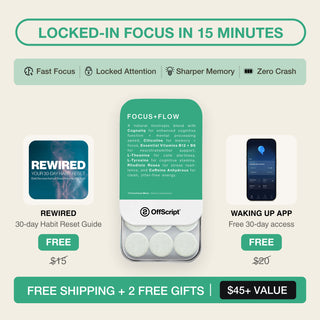
We built FOCUS+FLOW as a fast-dissolving mint. Two reasons, + neither is that pouches are bad.
The first is that a pouch keeps some of its dose. This is documented in the gum research, where relative bioavailability sat below capsules until corrected for incomplete release from the base. A pouch has the same physical issue: the milligrams on the tin are what went in, not necessarily what reached you, + the remainder goes in the bin. A mint dissolves completely.
The second is room. A pouch is small, caffeine is potent by weight, + a meaningful dose of L-theanine is 100mg to 200mg + considerably bulkier. Adaptogens at studied doses are bulkier again. That is why the category is overwhelmingly caffeine with a garnish, + it is not the fault of the formulators. It is the format telling them what fits.
A mint has the space. Which is why ours carries 150mg of L-theanine against 100mg of caffeine, plus L-tyrosine + rhodiola at real doses, rather than caffeine wearing a lab coat.
Patented coffee-fruit extract, clinically studied to support BDNF.
Calm, focused attention without the jitters.
Dopamine precursor for drive + focus under pressure.
Adaptogen that supports mental stamina under stress.
Clean, measured energy, smoothed by L-Theanine.
Raw material for acetylcholine, the memory + learning neurotransmitter.
Supports neurotransmitter production.
Supports cellular energy.
If you want the pouch format, buy a good pouch. If what you actually wanted was a complete focus formula that happens to absorb quickly, that is a different product.
Key Takeaways
- The category splits three ways: low-dose coffee-forward, high-dose energy, + focus blends.
- Judge on five things: stated mg per pouch, whether anything manages the caffeine, stated contact time, the excipient list, + honest onset claims.
- Most "best pouches" lists online are written by pouch brands. Verify doses on the tin in your hand.
- B vitamins are cofactors, not stimulants. L-theanine at a real ratio is the ingredient that earns its place.
- The format's dose ceiling is physics, not laziness, + it is why secondary ingredients arrive small.
- Every good property of a pouch is a removed stopping cue. Track milligrams.
Explore The Series
- Caffeine Pouches: Do They Actually Work?
- Energy Pouches: What They Are + What To Look For
- Caffeine Pouches vs Mints: Which Format Actually Wins?
- Caffeine Pouches vs Coffee: An Honest Comparison
- The Best Energy Mints
- What Is Nootropic Gum? Does It Actually Work?
References
- Kamimori GH, et al. The rate of absorption and relative bioavailability of caffeine administered in chewing gum versus capsules to normal healthy volunteers. International Journal of Pharmaceutics. 2002. PubMed
- Wickham KA, Spriet LL. Administration of Caffeine in Alternate Forms. Sports Medicine. 2018. PMC
- Sublingual and Buccal Delivery: A Historical and Scientific Prescriptive. Pharmaceutics. 2025. MDPI
- Owen GN, et al. The combined effects of L-theanine and caffeine on cognitive performance and mood. Nutritional Neuroscience. 2008. PubMed
- Kelly SP, et al. L-theanine and caffeine in combination affect human cognition as evidenced by oscillatory alpha-band activity and attention task performance. Journal of Nutrition. 2008. PubMed
FAQ
What is the best caffeine pouch?
It depends which of three lanes you want. Low-dose coffee-forward pouches suit caffeine-sensitive users and habit replacement. High-dose energy pouches suit training, driving and early shifts. Focus-blend pouches add ingredients beyond caffeine and are the most interesting corner, though the format limits how much of anything else will fit. Judge any product on stated milligrams per pouch, whether anything manages the caffeine, and stated contact time.
How much caffeine is in a caffeine pouch?
Doses across the category generally run from around 20mg at the low end to about 100mg at the high end, but formulations change frequently and many published comparisons are written by competing pouch brands. Read the tin you are holding rather than relying on a third-party figure.
Are focus pouches better than plain caffeine pouches?
Potentially, if the added ingredients arrive at meaningful doses. The problem is space. Caffeine is potent by weight so a full dose takes up almost no room, whereas a meaningful dose of L-theanine is 100mg to 200mg and considerably bulkier. That physical ceiling is why secondary ingredients in pouches tend to be small, regardless of how good the formulator is.
How long do you keep a caffeine pouch in?
Most brands recommend 15 to 30 minutes, and this matters more than people realise. Absorption through the mouth only happens while dissolved caffeine is against the tissue, which is the entire advantage the format offers over a capsule. Remove it early and most of the dose is simply swallowed and absorbed at ordinary speed.
Do caffeine pouches give you more caffeine than a pill?
No. They deliver it sooner. Research on caffeinated gum, which uses the same route, found peak plasma concentration at roughly 44 to 80 minutes versus 84 to 120 for capsules, with total absorption over the full time course broadly comparable. Any claim that the format increases the effective dose is not supported.
These statements have not been evaluated by the Food and Drug Administration. This product is not intended to diagnose, treat, cure, or prevent any disease. This article is educational and is not medical advice.