




The framing on most pages like this is wrong, so start here: no supplement treats ADHD. ADHD is a neurodevelopmental condition with established treatments, + the effect sizes for behavioural therapy + medication are in a different category from anything sold in a tub.
What supplements can do, in some cases, is correct a deficiency that is making things worse, or provide a modest lift to attention in the way a cup of coffee does. That is a narrower claim than the category makes + it is the honest one.
Worth Testing For, Then Correcting
This is the category with the most defensible logic, because you are fixing a real shortfall rather than adding something on top of normal.
Iron. Low ferritin is more common in people with ADHD symptoms + correcting it can help, particularly in children. The important caveat: iron is genuinely harmful in excess + supplementing without testing is a bad idea. Get ferritin measured, then act on the number.
Vitamin D. Widely low in people who work indoors. Correcting a deficiency supports general function. Correcting it will not resolve attention problems on its own.
Zinc + magnesium. Both are involved in neurotransmitter function + both show associations with symptom severity when low. Same rule applies: correcting a deficiency is reasonable, supplementing past normal is not, + magnesium above tolerance mainly produces digestive complaints.
The pattern is consistent. Test, correct, stop. Nobody sells you that because it is not a subscription.
Real But Modest Evidence
Omega-3s (EPA-heavy). The most studied supplement in this space. Meta-analyses tend to find a small benefit on attention measures, more consistent in children, with EPA-dominant formulas doing better than DHA-dominant ones. Small is the operative word. Worth taking for general health regardless, + it is a reasonable addition, not a treatment.
Caffeine plus L-theanine. Not ADHD-specific research, but the best replicated cognitive finding in healthy adults. The pairing improved accuracy on demanding attention-switching tasks + reduced susceptibility to distraction, with EEG work showing alpha-band changes consistent with sustained attention. Caffeine alone raises arousal, which is why coffee can leave you wired + scattered. The theanine changes the texture.
One caution worth stating: if you take a prescription stimulant, adding caffeine is a conversation with your prescriber first.
Narrow, Situational Evidence
L-tyrosine. A dopamine + noradrenaline precursor. The research supports a specific claim: benefit under acute stressors that deplete those neurotransmitters, such as sleep deprivation, cold, or sustained high cognitive load. It does not appear to do much in rested, unstressed people, + it is not an ADHD intervention. Think hard day, not daily habit. The full evidence breakdown is in what L-tyrosine does and does not do for ADHD.
Rhodiola rosea. Evidence sits on mental fatigue under prolonged demand rather than on attention itself (Darbinyan et al., 2000). Useful for stamina late in a long day. Different target.
Citicoline. A choline source feeding acetylcholine, which is involved in attention + learning. Mechanism is sound, the human evidence is thinner than the marketing.
Popular But Weak
- Ginkgo biloba. Long history, inconsistent results, mostly studied on memory in older adults rather than executive function.
- Bacopa monnieri. Some memory findings over long timelines, little on ADHD specifically, + it commonly causes digestive upset.
- Pycnogenol, saffron, ginseng. Small individual studies exist. The evidence base is nowhere near strong enough to describe them as effective.
- Elimination diets + food dye removal. Helps a small subset with genuine sensitivities. Not a general answer, + restrictive diets carry their own costs in children.
- Anything called "natural Adderall." The name is doing the work the evidence cannot.
What Actually Moves The Needle More
The unglamorous answer, + the honest one.
Sleep. Short sleep produces a near-perfect impersonation of attention problems + makes genuine ADHD substantially worse. No compound in this article compensates for it.
Exercise. Among the most consistent non-pharmacological findings for executive function.
External structure. Lists, timers, environmental design, removing decisions before you need to make them. For follow-through specifically, this outperforms every supplement on this page, + it costs nothing.
What We Make, And What It Is Not
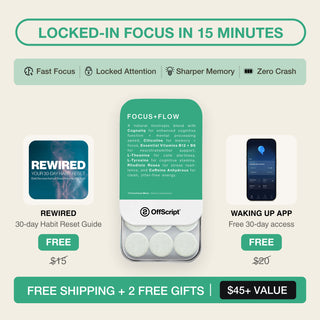
FOCUS+FLOW is a fast-dissolving mint built around the caffeine + L-theanine pairing at doses that match the research, with tyrosine + rhodiola for the harder days. It is a focus supplement for healthy adults. It is not an ADHD treatment + we will not describe it as one.
Patented coffee-fruit extract, clinically studied to support BDNF.
Calm, focused attention without the jitters.
Dopamine precursor for drive + focus under pressure.
Adaptogen that supports mental stamina under stress.
Clean, measured energy, smoothed by L-Theanine.
Raw material for acetylcholine, the memory + learning neurotransmitter.
Supports neurotransmitter production.
Supports cellular energy.
Key Takeaways
- No supplement treats ADHD. Established treatments operate at a different magnitude entirely.
- Iron, vitamin D, zinc + magnesium are worth testing. Correct a real deficiency, then stop.
- Never supplement iron without a ferritin test. Excess is harmful.
- Omega-3s show a small, real benefit, more consistent in children, with EPA-heavy formulas.
- Caffeine with L-theanine has the best replicated attention data in healthy adults.
- Tyrosine is for acute stressors, not daily use. Rhodiola targets fatigue, not focus.
- Sleep, exercise + external structure beat everything on this page.
Explore The Series
- Natural Supplements for ADHD in Adults
- OTC Adderall Alternatives: What The Evidence Supports
- L-Tyrosine: Dopamine Precursor For Pressure
- The ADHD Dopamine Crash
- Rhodiola Rosea for Mental Fatigue: What the Science Says
- The Best Magnesium for Anxiety
References
- Owen GN, et al. The combined effects of L-theanine and caffeine on cognitive performance and mood. Nutritional Neuroscience. 2008. PubMed
- Kelly SP, et al. L-theanine and caffeine in combination affect human cognition as evidenced by oscillatory alpha-band activity and attention task performance. Journal of Nutrition. 2008. PubMed
- Darbinyan V, et al. Rhodiola rosea in stress induced fatigue. Phytomedicine. 2000. PubMed
- Boyle NB, Lawton C, Dye L. The effects of magnesium supplementation on subjective anxiety and stress: a systematic review. Nutrients. 2017. PubMed
FAQ
What is the best supplement for ADHD?
There is no supplement that treats ADHD. The most defensible approach is testing for and correcting a genuine deficiency in iron, vitamin D, zinc or magnesium, since low levels can worsen symptoms. Beyond that, omega-3s show a small benefit in meta-analyses and caffeine paired with L-theanine has good evidence for attention in healthy adults. None of these substitute for assessment and established treatment.
Can supplements replace ADHD medication?
No, and stopping prescribed medication in favour of supplements generally makes things worse. The effect sizes are not comparable. If your medication is not working well, that is a conversation with your prescriber rather than a reason to self-manage.
Do omega-3s help with ADHD?
Modestly. Meta-analyses tend to find a small benefit on attention measures, more consistent in children than adults, with EPA-dominant formulas performing better than DHA-dominant ones. It is a reasonable addition with general health benefits, not a treatment.
Should I take iron for ADHD?
Only after a ferritin test showing you are low. Low iron stores are more common in people with ADHD symptoms and correcting a genuine deficiency can help. Iron is harmful in excess, so supplementing without testing is a bad idea. Ask your doctor to measure it rather than guessing.
Does magnesium help ADHD?
Correcting a genuine deficiency may help, since magnesium is involved in neurotransmitter function and low levels are associated with greater symptom severity. Supplementing past normal levels does not add benefit, and taking more than you tolerate mainly produces digestive problems. A systematic review of magnesium for anxiety and stress found the evidence suggestive but limited by study quality.
These statements have not been evaluated by the Food and Drug Administration. This product is not intended to diagnose, treat, cure, or prevent any disease. This article is educational and is not medical advice.